


Content warning: Suicide is mentioned in this article
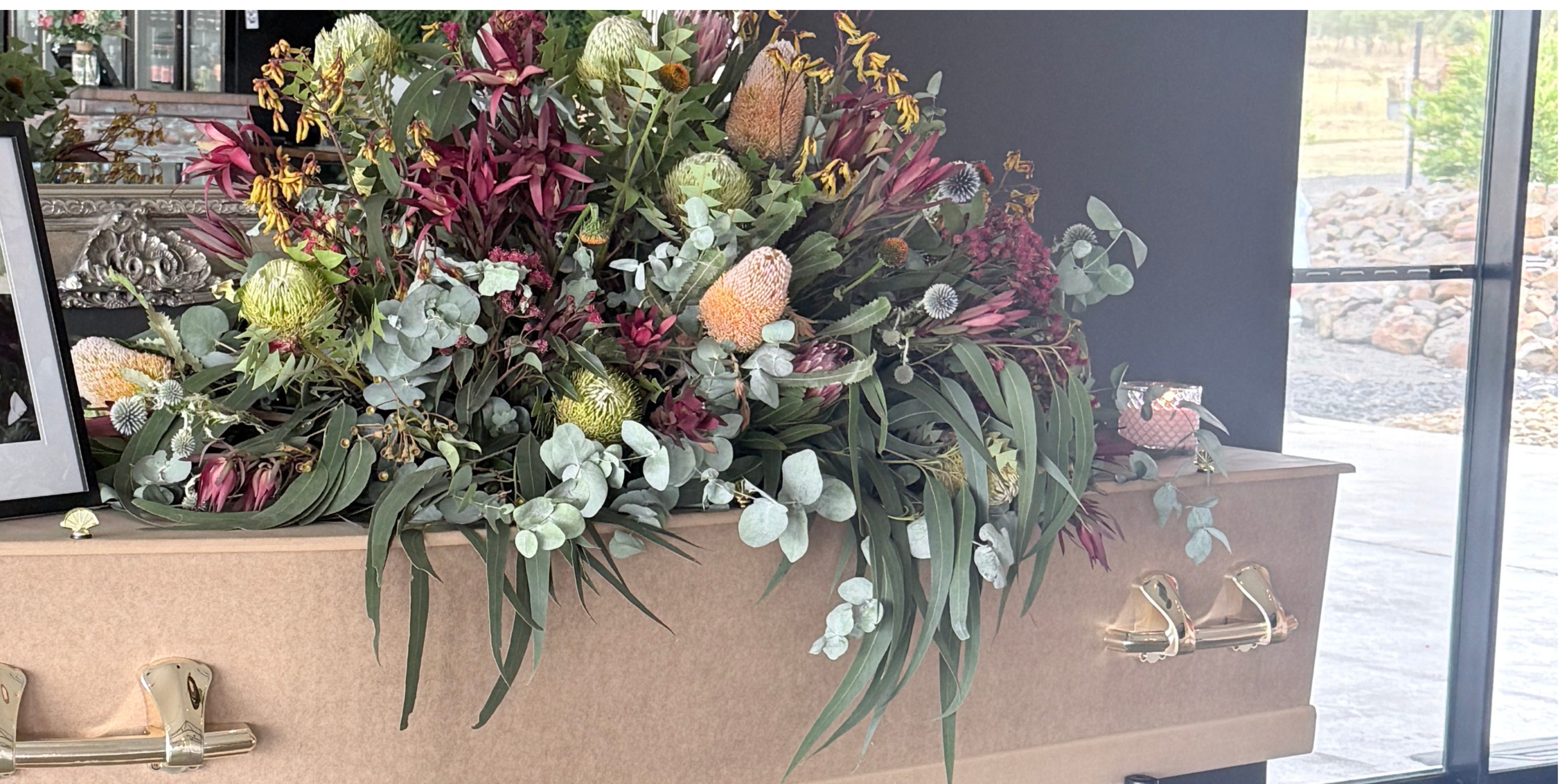
Three years ago, when my sister was opening the doors to her new function centre on her farm, we discussed creating a funeral business. It was a moment when both our worlds collided, because I’d found myself drawn to wanting to tell people’s grief stories.
The venue opened, the first wedding booking came within a week, and as far as brides were concerned all roads led there for their special day. As a brand new exceptionally and wonderfully busy wedding venue there was no time, energy or other resources to consider funerals too. As an exceptionally and unexpectedly busy marriage celebrant I also didn’t have the time, energy or other resources to consider funerals too.
Last year, I applied and was selected to be part of a group called ‘Words For The Recently Deceased.’ It was designed for people considered “death thinkers” to meet once a month and bring a poem that aligned with that month’s topic. The group was created by two quite new celebrants who work at a funeral home doing funerals the way I’ve always felt they should be done. They wanted to gather a stockpile of poetry to use in their services.
When I received an email saying “we have good news from the other side; you’re in” I was super excited. Mainly I was hoping to meet some interesting people, and also gain a firsthand insight into funerals. I love poetry too. We met at the funeral home – they have two cats who live there, including one called Sharon who joined us each time and made use of all the laps in the room. We even had one meeting in the morgue.
Working in funerals is a tough gig. I frequently hear that it’s immensely rewarding – and, it takes a toll. I relished the stories I heard – give me raw and real any day – but by the time our meetings ended I’d decided that I didn’t want to work in a funeral business. I thought I’d still consider being a funeral celebrant, and left it at that.
Last week I officiated my first funeral. I was asked to do it by one of my sister’s friends. My inner voice, that I refer to as my guidance or inner wise woman, told me to say “yes”.
I’m not quite sure how to tell you the rest of the story. I think it’s had a larger impact on me than I first realised and I’m not sure I have the best words for that yet. Let’s see how this goes…
The funeral was for a man whose body was found at the bottom of a cliff. His car was at the top. He was 48 years-old. He has a wife and three daughters, aged 23, 13 and 12. His wife was absolutely devastated, so my sister’s friend organised everything to do with the funeral. I was asked to write the eulogy.
In many ways I was buffered by not speaking to the family, yet I was concerned I wouldn’t be able to capture this man’s life in ways he deserved and deliver a truly meaningful service. There was also a part of me wondering how I’d managed to find myself officiating my first funeral for a family feeling shocked, deeply hurt, overwhelmed by grief, and likely ashamed, guilty and angry too.
I didn’t speak to the man’s wife once, including on the day of the funeral. She and her daughters walked in one minute before the service started and left as soon as it ended and she’d helped carry the coffin to the hearse. She wore dark sunglasses throughout the service, as did several other people.
It’s difficult to find words for the intensity of the energy in the room. It was unlike anything I’d encountered before, in any space I’ve held.
I knew I had to call on all my years of professional presenting, on TV, radio and stages, while staying fully connected with my emotions. I needed to convey the gravity of the family’s heartbreak with sensitivity and genuine care, while somehow connecting with every single person in that room of 100 people.
I decided to do what I’ve always done: create a sacred space. I started the funeral with an invitation for everyone to close their eyes and take a few deep breaths, so they could arrive and be present for what was about to happen. A few people took deep breaths. I then asked them to connect with the person next to them, because we’re all doing this together, sharing in the shock and grief of losing this man so suddenly. Not one single person did that. They all stared at me in silence. I wondered if I’d messed up before the service had even properly begun.
I said that funerals are referred to as a celebration, but they don’t always feel that way. I said this is an opportunity to reflect, and whatever emotions arise are welcome. Sadness, sorrow, tears, perhaps even a moment of joy or laughter – they’re all natural, and all welcome.
Everyone stared at me. For a moment I wondered if they all thought I was completely nuts.
Then I officially started the funeral. Someone had already lit the candle on the coffin, so when I asked the people who’d been chosen to come up and light it there was a problem, which fortunately and awkwardly we quietly laughed off. After I read the eulogy, two people had planned to speak and one couldn’t bring himself to do it. I read a letter from the 23 year-old daughter to her Dad, while she sat directly in front of me sobbing. I read a poem on behalf of the three daughters then we listened to a song this man had chosen for his 12 year-old daughter’s birth. We watched a slide show with two songs that the two younger daughters had chosen. I read another poem and then some farewell words I’d written, before inviting people to come forward, if they wanted to, to place a sprig of rosemary on the coffin.
The funeral director brought me the basket with the rosemary. I wasn’t expecting to have to hold it. But I did, as I stood right next to the coffin. A wave of people came forward. Then there was a gap and a couple more people came. Another gap, and then an older man with a woman who was walking him to the coffin. “Say goodbye to him!” she demanded. “Say goodbye!” This man started crying and bent down to lean his head on the lid of the coffin. A woman came over sobbing and did the same thing.
After they’d finished and gone back to their seats, I didn’t know where to put the rosemary basket and was fumbling around looking for somewhere then the funeral director came and took it from me.
I said a few final words of thanks to everyone for coming, the music started, and the pall bearers came to carry the coffin with me walking in front and leading them to the hearse. Then everyone formed a guard of honour and I walked with the funeral director in front of the hearse, as was the funeral home’s protocol.
A woman who worked there said to me afterwards, “That service must have been so hard to write.” I told her it was easy, but delivering it not so much.
And, I can’t help but own that I felt at home somehow. I love live, embodied, emotionally honest spaces.
Officiating the funeral reminded me of the aliveness of grief. I was immersed in a particular type of aliveness that only arrives with heartbreak.
In loss, we discover a sacred connection between what feels unbearable and what’s truly alive. It teaches us to appreciate what’s fleeting, fragile and real. In grief, life becomes more vivid. We become our most real, and we have the opportunity to discover more beauty, aliveness and even joy than we knew possible. Grief carries enormous power and medicine for us.
The rapture of being fully alive. Isn’t that what we all want? Grief is a gateway, and officiating the funeral made me feel more fully alive. It moved me. It’s still moving through me.
I was grateful to receive a generous review from the guy who organised the funeral on the family’s behalf. His words touched my heart. This particular sentence was the most meaningful to me: “She didn’t just conduct a funeral; she created a space where we could grieve, remember, connect, and begin to heal together.” It seems I didn’t mess up after all.
I want to live in a world where grief, loss and sorrow are honoured as sacred parts of being human. I want spaces where people can be witnessed, held and reminded that we don’t carry grief alone.
At my first funeral I felt like I’d made a small contribution to doing things a little bit better. I made this offering afterwards. May everyone who’s grieving be supported in whichever ways they need for as long as they need.

